
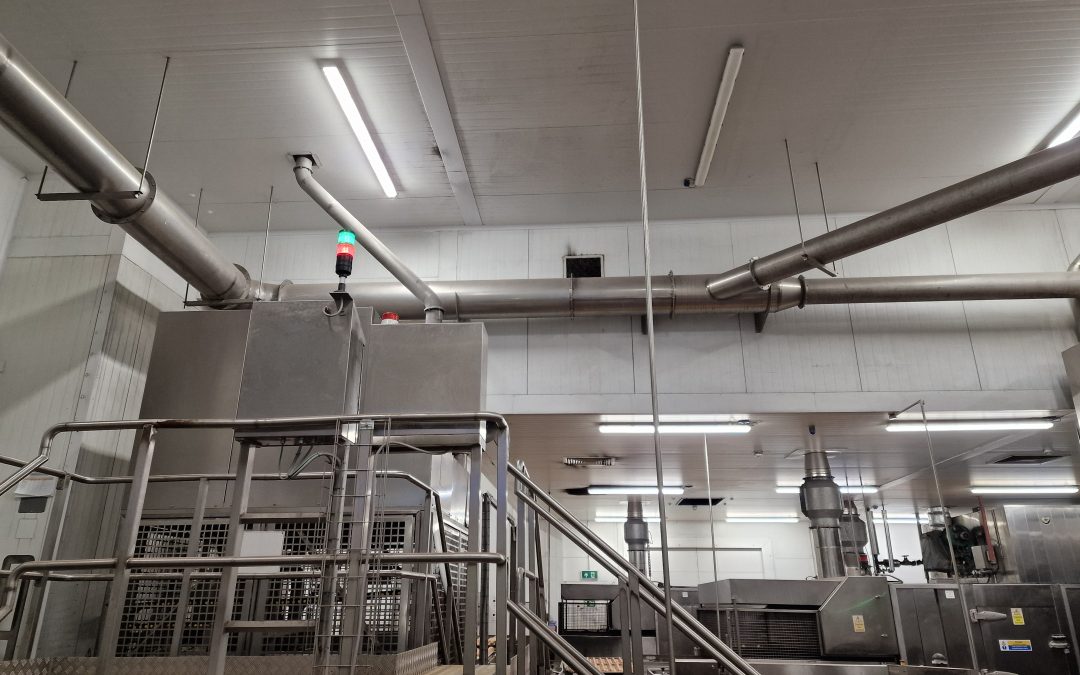
A leading UK food manufacturer producing a wide range of freshly prepared bakery products and powdered food ingredients required specialist LEV testing to assess the performance and compliance of its flour dust extraction systems.
Production activities, including tray cleaning and ingredient sieving, generated airborne flour dust, making effective dust extraction essential for protecting employees, maintaining food safety standards and complying with the Control of Substances Hazardous to Health (COSHH) Regulations.
The Challenge
The site operated two Local Exhaust Ventilation (LEV) systems designed to control flour dust during:
- Tray cleaning operations
- Sieving of powdered ingredients, including flour and sugar
Neither system had undergone a Thorough Examination & Test (TExT) for an extended period. Both systems recirculated filtered air back into the workplace, meaning filtration performance, system integrity and ongoing monitoring were critical to maintaining a safe working environment.
During our initial assessment, we identified that neither system could demonstrate compliance due to several significant issues, including:
- Failed and degraded filter media
- Mechanical defects
- Ductwork design limitations
- Reduced extraction performance
As flour dust is a respiratory sensitiser and one of the leading causes of occupational asthma in the food manufacturing industry, effective extraction and regular LEV testing are essential to minimise employee exposure and comply with COSHH Regulation 9, HSG258, and DSEAR where applicable.
Our Solution
Impact Technical Services carried out a comprehensive LEV Thorough Examination & Test (TExT) on both dust extraction systems in accordance with COSHH Regulation 9 and HSG258 – Controlling Airborne Contaminants at Work.
Our assessment included:
- Airflow and system performance testing
- Mechanical condition inspections
- Filter integrity assessment
- Ductwork evaluation
- Explosion protection review in accordance with DSEAR
- Detailed compliance reporting and remedial recommendations
- Tray Cleaning Dust Extraction System
- Inspection identified several critical issues preventing safe operation, including:
- Failed filter media
- Damaged explosion relief membrane
- No differential pressure monitoring across the filters
As associated machinery had not yet been commissioned, full performance testing will be completed once installation is complete.
- Sieving Dust Extraction System
- Testing identified several defects affecting extraction performance, including:
- Failed and contaminated filter media
- Incorrect fan rotation, significantly reducing airflow
- Ductwork configuration resulting in inadequate conveying velocities
- A full programme of remedial recommendations was provided to restore safe, compliant operation.
The Result
Our LEV assessment provided the customer with a clear understanding of the condition and performance of both flour dust extraction systems, identifying the critical issues preventing compliance and effective dust control.
Following completion of the recommended remedial works, the systems will be capable of:
- Achieving compliance with COSHH Regulation 9, HSG258 and DSEAR
- Restoring effective control of airborne flour dust
- Reducing employee exposure to hazardous dust
- Improving extraction system performance and reliability
- Establishing a benchmark for future statutory LEV Thorough Examination & Testing
By identifying these issues before they developed into more significant operational or compliance risks, the customer now has a clear roadmap to improve workplace air quality, protect employees and maintain safe, efficient food production.
Is your LEV system due for a Thorough Examination and Test? Contact us today for a free, no-obligation quote.