
KI-Discus Testing For Microbiological Safety Cabinets (MBSC)
Impact Technical Services provides specialist KI-Discus testing for microbiological safety cabinets (MBSCs) across the UK. Our qualified engineers carry out KI-Discus containment testing to assess the performance of safety cabinets and verify that they are providing effective protection against airborne contaminants. We provide clear, detailed test reports and expert advice to help laboratories maintain safe working environments and meet relevant health and safety requirements.
Potassium Iodide Discus Testing
What Is KI-Discus Testing?
KI-Discus testing checks how well a microbiological safety cabinet (MSC) contains aerosols and protects the operator.
A fine potassium iodide (KI) mist is released inside the cabinet using a spinning-disc generator. To see if any of this mist escapes, centripetal collectors are placed inside or just outside the front opening to capture airborne particles on small filter membranes.
After sampling, the membranes are dipped in a palladium chloride solution. Any trapped droplets develop into visible grey or brown spots.
The grey and brown dots are used to calculate the operator protection factor. Any value above 1 × 10⁵ is considered non-compliant.
KI-Discus testing is the recognised method for assessing operator protection in open-fronted microbiological safety cabinets, as specified in EN 12469.

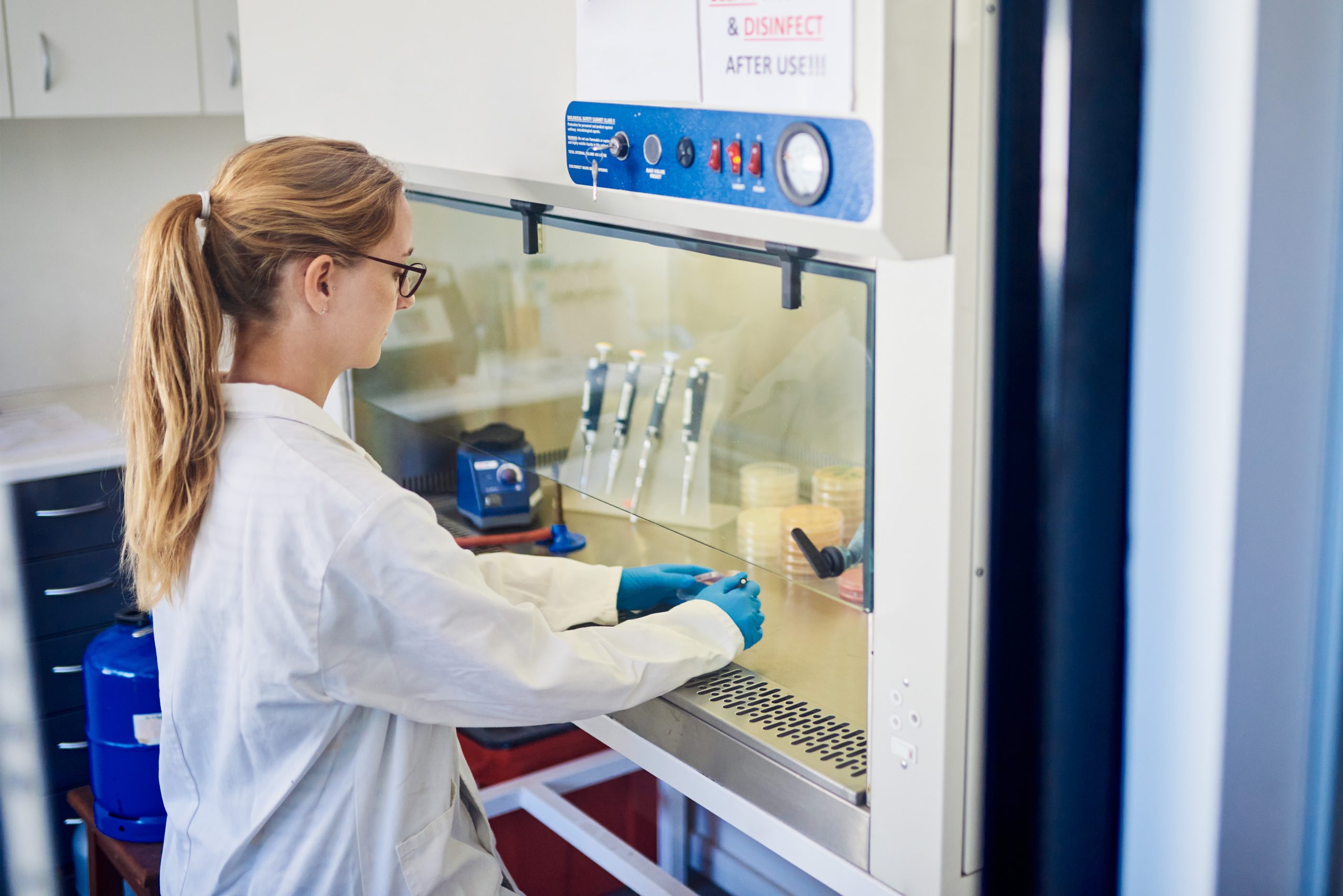
Confidence in Air System Compliance
Why Is KI-Discus Testing Important?
KI-Discus testing confirms whether your safety cabinet is protecting laboratory personnel from exposure to hazardous aerosols, pathogens, or particulates.
It provides confidence that your cabinet is functioning correctly and meeting compliance requirements.
KI-Discus testing:
-
Demonstrates the containment performance of the cabinet
-
Ensures compliance with EN 12469 and laboratory quality standards
-
Protects staff from exposure to harmful aerosols
-
Identifies leaks, airflow issues, or mechanical faults
-
Ensures safe operation during sensitive laboratory processes
-
Prevents downtime by detecting problems early
Regular KI-Discus testing is essential wherever operator safety and reliable containment cannot be compromised.
Industry-Specific KI-Discus Testing
Industries We Support
We provide KI-Discus testing across a range of sectors, including:
Universities
Pharmacy
Biomedical
Microbiology
Hospitals
Biotechnology Facilities
Clinical Labs
Cleanrooms
What’s Involved in a KI-Discus Test?
Cabinet Inspection
We assess the MSC’s condition, airflow, filters, and operating environment.
KI Aerosol Generation
A controlled potassium iodide mist is released inside the cabinet using a spinning-disc generator.
Air Sampling
Centripetal samplers collect any KI particles that escape past the working aperture.
Analysis & OPF Calculation
Collected samples are carefully treated and analysed to count KI spots and accurately determine the Operator Protection Factor.
Certification & Report
You receive a full report including results, compliance status, and any recommended actions. Most tests are completed quickly, with minimal downtime for your laboratory.
KI-Discus Testing FAQs
Frequently Asked Questions
What does KI-Discus testing measure?
A KI-Discus test measures the ability of a microbiological safety cabinet to contain airborne particles and protect the operator from exposure. A controlled KI aerosol is generated within the cabinet and samples are collected around the working aperture. The resulting measurements are used to calculate the cabinet’s Operator Protection Factor (OPF).
The test can therefore identify potential problems with containment performance that may not be apparent from airflow measurements alone, providing an important part of a microbiological safety cabinet’s overall performance assessment.
How often should KI-Discus testing be carried out?
KI-Discus testing should be carried out at intervals appropriate to the cabinet, its application, the manufacturer’s recommendations, the laboratory’s risk assessment and the applicable standards or procedures. Annual testing is commonly used for microbiological safety cabinets, although more frequent testing may be appropriate for higher-risk applications or where cabinet performance could be affected by intensive use.
Testing should also be considered following significant maintenance, repairs, relocation or modifications that could affect containment performance.
Impact Technical Services can advise on an appropriate testing programme based on your cabinet and laboratory requirements.
How does KI-Discus testing relate to BS EN 12469?
KI-Discus testing is an established method for assessing operator and aperture protection performance in open-fronted microbiological safety cabinets and is associated with the EN 12469 testing framework. BS EN 12469:2000 includes the potassium iodide method for assessing operator protection, while the standard has now been restructured into a series of standards, including BS EN 12469-5:2025, which covers the installation, commissioning and routine testing of biological safety cabinets.
The appropriate testing requirements depend on the cabinet type, application and stage of testing. Impact Technical Services can advise on the relevant testing requirements for your microbiological safety cabinet and provide the appropriate performance testing and reporting.
What is microbiological safety cabinet testing?
Microbiological safety cabinet testing is the process of assessing whether a safety cabinet is operating correctly and providing the intended level of protection for laboratory personnel, the environment and, where applicable, the work being carried out inside the cabinet.
Testing can include airflow measurements, containment testing, HEPA filter integrity testing, alarm checks and other performance checks, depending on the cabinet and its application.
KI-Discus testing specifically assesses containment and operator protection. DOP testing, by comparison, assesses the integrity of HEPA filtration, meaning the two tests provide different information and can form complementary parts of a cabinet’s overall testing programme.
BS EN 12469 covers performance requirements and testing of microbiological safety cabinets, with the 2025 series now providing more specific requirements for different cabinet classes and routine testing.
What is the difference between KI-Discus and DOP testing?
KI-Discus and DOP testing assess different aspects of microbiological safety cabinet performance.
KI-Discus testing assesses containment and operator protection by introducing a potassium iodide aerosol and measuring whether particles escape through the cabinet’s working aperture.
DOP testing assesses HEPA filter integrity by challenging the filter with an aerosol and measuring whether any aerosol penetrates through the filter or escapes through leaks in the filter installation.
In simple terms:
KI-Discus – Cabinet containment and operator protection
DOP – HEPA filter integrity and leakage
Airflow testing – Air velocity and airflow performance
KI-Discus and DOP testing are therefore not interchangeable. Depending on the cabinet and application, both may be required as part of a comprehensive testing and maintenance programme.
What happens if a microbiological safety cabinet fails KI-Discus testing?
A failed KI-Discus test indicates that the cabinet has not demonstrated the required containment or operator protection performance under the test conditions. The cause should be investigated before the cabinet is returned to work where effective containment is required.
Potential causes can include incorrect or unstable airflow, cabinet damage, mechanical faults, problems with filters or seals, unsuitable installation conditions, or disturbances around the cabinet’s working aperture.
Impact Technical Services can investigate the cause of a failed test, recommend or undertake remedial work where appropriate, and retest the cabinet to verify that containment performance has been restored. A clear test report provides a record of the results and any actions required.
Which microbiological safety cabinets can be tested using KI-Discus?
KI-Discus testing can be used to assess the operator and aperture protection performance of open-fronted microbiological safety cabinets, including Class I and Class II cabinets. The KI-DISCUS system is also designed for certain hybrid and specialist containment applications.
The appropriate test method depends on the cabinet design, intended use and applicable testing requirements. Impact Technical Services can advise on whether KI-Discus testing is appropriate for your cabinet.
What does a KI-Discus test report include?
A KI-Discus test report records the testing undertaken, the results obtained and the cabinet’s Operator Protection Factor, together with any relevant observations or recommendations. This provides laboratories with documented evidence of the cabinet’s containment performance and a useful record for maintenance, quality and compliance purposes.
Where issues are identified, Impact Technical Services can explain the findings and advise on appropriate remedial action and retesting.

Precision Testing by Experts
Why Choose Us for KI-Discus Testing?
- Certified MSC and containment-testing engineers
- Extensive experience across laboratory, pharmaceutical, and research environments
- Fully compliant KI-Discus testing (EN 12469)
- Accurate measurements with calibrated equipment
- Clear, easy-to-understand reports
- Minimal disruption to your laboratory operations
- Fast response times and dependable support
We deliver precise, reliable containment testing to keep your people and processes protected.
Built on Compliance and Safety Excellence
Your single-source provider
Why choose Impact
We provide complete workplace air quality solutions for manufacturing, laboratories, education, healthcare and research environments.
From LEV testing and laboratory fume cupboard testing to extraction system design, installation, servicing and planned maintenance, our BOHS-qualified engineers and CoC-qualified management deliver compliant, reliable and effective solutions that help organisations protect their people, meet regulatory requirements and maintain high-performing workplaces.
Experienced
30 years of nationwide coverage
Qualified
P601, P602, P603, P604 qualified LEV technicians
Outstanding Service
We have a high percentage of returning customers
Expertise
Experts in LEV project management
Warranty
12 month warranty on all installations